Top Signs You Need Gate Repair Service — Don’t Ignore These
A gate that hesitates for two seconds before moving isn’t just being ‘a little slow’ — it’s often a capacitor warning you it has maybe 30 days left before it quits mid-cycle and jams the leaf against the post. Many homeowners in Las Vegas assume minor gate quirks will sort themselves out, but these subtle shifts are usually the first whispers of a bigger, more expensive problem. Ignoring them can lead to complete system failure, leaving you with a security vulnerability or a gate that’s just plain stuck. We’ve seen countless situations where a simple fix, addressed early, would have saved significant time and money. Don’t wait until your gate is completely unresponsive; understanding these early warning signs can save you a lot of hassle and keep your property secure.
If you’re experiencing any of these issues and would rather not attempt a DIY fix, Dependable Gate Repair Solutions offers free estimates for all gate repair needs in Las Vegas. Call us at (725) 444-7639.
Gate Hesitation: More Than Just a Slow Opener
That slight pause before your gate begins to move, or the sluggish crawl it makes to its open or closed position, is one of the most common, yet often overlooked, signs that your gate system needs attention. In Las Vegas, where heat can take a toll on mechanical components, this hesitation is a red flag that shouldn’t be ignored. It typically indicates a strain on the gate opener’s motor or a weakening of its internal components, like the capacitor. A capacitor is essentially the “jump-start” for the motor; when it starts to fail, the motor struggles to get going, leading to that noticeable delay. Over time, this constant struggle puts undue stress on the motor itself, potentially leading to a premature burnout. We’ve seen this happen with brands like LiftMaster and Mighty Mule alike. Another culprit could be worn-out gears within the opener unit, which are working harder to overcome resistance. This resistance might stem from the gate itself — perhaps the tracks are dirty, or the hinges are stiff. Addressing this hesitation early can prevent a complete motor failure, which is a much more costly repair than a simple capacitor replacement or a thorough lubrication.
- Motor Strain: The opener’s motor is working harder than it should, often due to a failing capacitor or worn internal gears.
- Mechanical Resistance: The gate itself might be causing the issue, with dirty tracks, stiff hinges, or misaligned components creating drag.
- Capacitor Weakness: A failing capacitor struggles to provide the initial surge of power needed to start the motor.
- Gear Wear: Internal gears within the opener can wear down, making it harder for the motor to operate smoothly.
Reversal or Stopping Mid-Cycle: A Critical Safety and Mechanical Warning
When your gate starts to move and then abruptly reverses direction, or simply stops halfway through its cycle, it’s not just an annoyance; it’s a critical warning sign that demands immediate attention, especially for homeowners in Las Vegas. This behavior points to a problem with the gate’s safety features or its limit settings. The most common cause is a malfunctioning safety sensor or loop detector. These systems are designed to prevent the gate from closing on an obstruction, like a car or a person. If they are dirty, misaligned, or faulty, they can falsely detect an obstruction, causing the gate to reverse. We’ve encountered this frequently with DoorKing and FAAC systems. Another possibility is an issue with the logic board or control panel, which might be misinterpreting signals or experiencing electrical faults. In some cases, a weak or failing motor might not have the power to complete its travel, especially if it encounters even minor resistance. This can also be a sign of a failing power supply or a loose connection somewhere in the wiring. Forgetting about this type of issue could lead to the gate becoming completely inoperable or, worse, malfunctioning in a way that creates a safety hazard.
- Faulty Safety Sensors: Obstruction detection systems may be dirty, misaligned, or broken, triggering false alarms and reversals.
- Limit Switch Issues: The gate’s internal “stop” points may be incorrectly set or failing, causing it to halt or reverse prematurely.
- Control Board Problems: The main logic board may have electrical faults or be misinterpreting signals, leading to erratic behavior.
- Power Supply Fluctuations: Inconsistent power delivery to the opener can cause it to stop or reverse unexpectedly.
Grinding, Squealing, or Unusual Noises: The Sound of Wear and Tear
The soundtrack to a failing gate system is often a symphony of unpleasant noises. Grinding, squealing, or loud clanking sounds coming from your gate opener or the gate itself in Las Vegas are unmistakable indicators of mechanical distress. These sounds typically arise from worn-out gears within the opener unit, often seen in systems like BFT or Linear. As gears grind against each other, they produce that harsh metallic noise, and continued operation will only accelerate the wear, leading to complete gear failure. Another common source of noise is the gate’s hinges or rollers. If they are dry, rusted, or damaged, they will create friction and noise as the gate moves. We often find that a simple lubrication can solve squeaking, but persistent grinding suggests a more serious issue with the internal mechanics or structural components. Sometimes, a loud bang or clank might indicate that a part has become loose or is about to break off entirely, posing a risk of damage to the gate leaf or surrounding property. This is why we always advise homeowners to pay attention to these auditory clues.
- Worn Opener Gears: Internal gears within the motor unit are grinding against each other due to wear.
- Stiff or Damaged Hinges/Rollers: Friction from unlubricated, rusted, or bent hinges and rollers causes squeaking and scraping.
- Loose Components: Parts of the gate or opener mechanism may have become loose and are rattling or banging during operation.
- Obstructions in Tracks: Debris or damage within the gate’s track can cause it to scrape and make noise as it moves.
Visual Signs on the Gate Leaf and Posts: Beyond the Opener
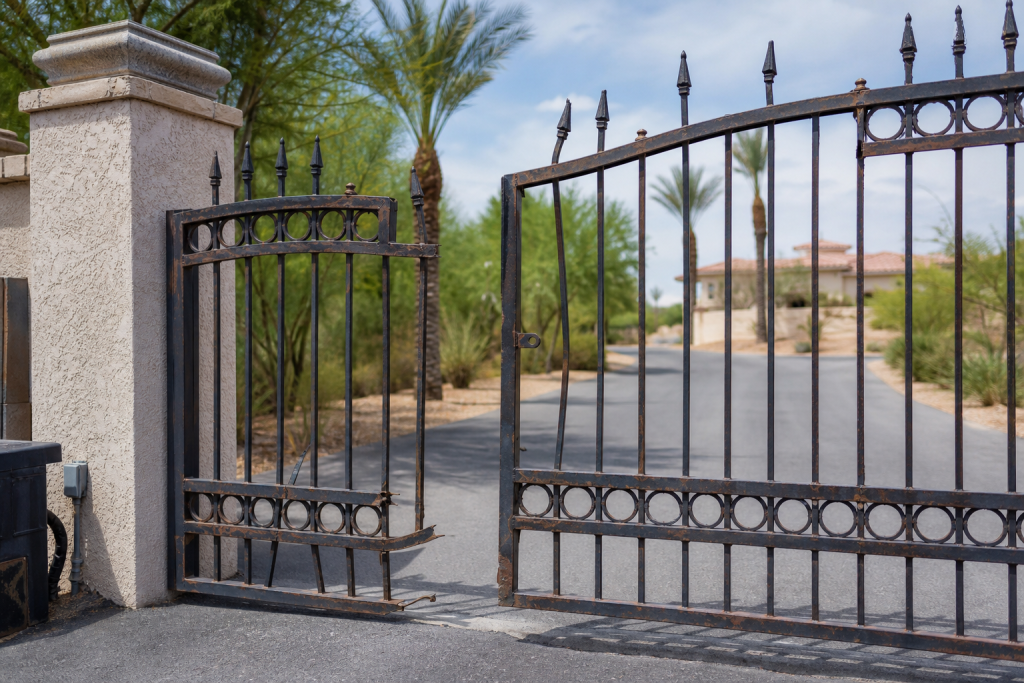
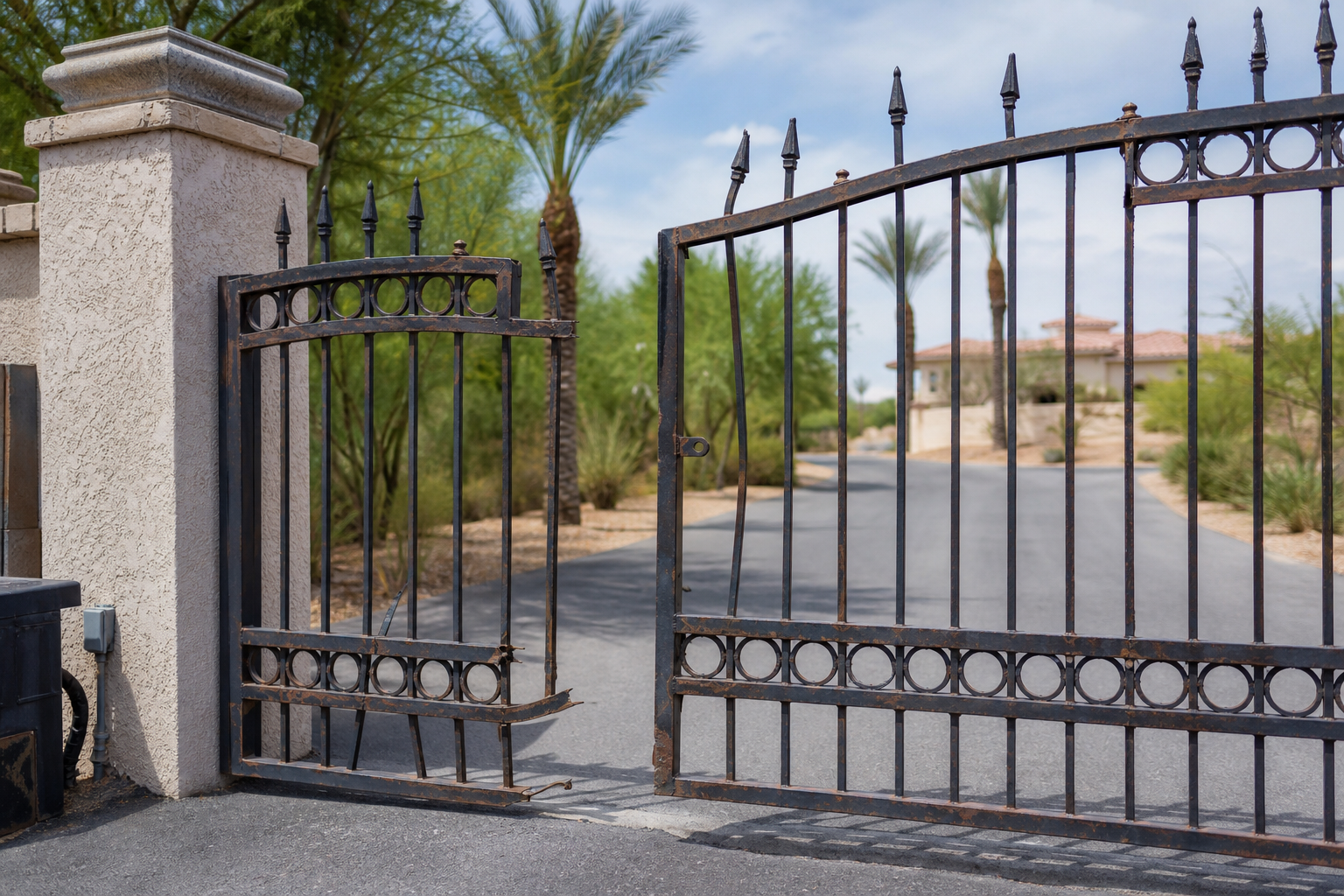
Don’t just focus on the opener; the gate leaf and its supporting posts can tell you a lot about its overall health, and these are signs we often spot during our service calls across Las Vegas. Look for visible cracks in the gate’s welds, especially around the frame or where the hinges attach. These cracks, while sometimes appearing minor, can indicate structural weakness that could lead to the gate sagging or even breaking. Similarly, a noticeable gap developing between the gate leaf and its hinges, or a hinge that appears bent, suggests the gate is no longer hanging straight. This misalignment puts extra strain on the opener and can cause it to work harder, leading to premature wear. A leaning post is another critical visual cue. If a gate post is tilting away from the gate or leaning inward, it means the ground beneath it has shifted, or the post itself is compromised. This not only affects the gate’s operation but also its security, as a wobbly post can be easier to force open. We’ve seen this impact gates from Viking to Ghost Controls. Addressing these visual cues early can prevent costly structural repairs or a complete gate system failure.
- Cracked Welds: Visible fractures in the gate’s metal structure, particularly around attachment points.
- Hinge Wear or Damage: Gaps in hinges, bent hinge plates, or a gate that appears to be sagging.
- Leaning Posts: Gate posts that are visibly tilted or unstable due to ground shifting or structural compromise.
- Misalignment: The gate leaf is not sitting flush with its frame or track, indicating underlying structural issues.
Intermittent Functionality: The Sneaky Problem
Perhaps the most frustrating sign that your gate needs repair in Las Vegas is when it works sometimes, but not others. This “intermittent” behavior is often a precursor to a complete breakdown and can be more challenging to diagnose than a gate that’s completely dead. It usually points to an electrical issue, such as a loose wire connection, a failing circuit board, or a problem with the remote control receiver. We’ve seen this frequently with Elite gate systems. The intermittent nature means that the connection might be there one moment and gone the next, leading to unpredictable operation. It could also indicate that a component is overheating. As a part gets warmer during operation, its performance degrades, causing the gate to stop. Once it cools down, it might work again for a short period. This cycle is a strong indicator that a component is on its way out. Unlike a completely failed system, which clearly signals a need for repair, intermittent issues can lull homeowners into a false sense of security, leading them to delay calling for service until the problem becomes permanent.
- Loose Wiring: Connections that periodically fail due to vibration or thermal expansion/contraction.
- Overheating Components: Parts that function correctly when cool but falter as they heat up during operation.
- Failing Circuit Boards: The control unit might have intermittent faults, leading to unpredictable responses.
- Remote/Receiver Issues: Problems with the remote or the gate’s receiver unit can cause sporadic activation.
Remote and Keypad Malfunctions: More Than Just a Dead Battery
When your remote control or gate keypad stops working, it’s easy to assume the problem lies with the remote itself or the batteries. However, in Las Vegas, these issues can often be a symptom of a deeper problem within the gate’s access control system. If you’ve replaced the batteries in your remote multiple times and it still won’t activate the gate, the issue might be with the gate opener’s receiver board. This board can fail over time, losing its ability to communicate with your remotes. Similarly, a keypad that’s unresponsive, even after ensuring it’s receiving power, could indicate a fault in the keypad itself or, more commonly, in the wiring that connects it to the control panel. We’ve seen this with various brands, including LiftMaster and DoorKing. Sometimes, a keypad might appear to work but fails to send the correct signal, leading to the gate not operating. This can be due to internal damage to the keypad or a communication error with the main control board. Neglecting these access control issues can leave you locked out or unable to secure your property, which is a significant concern for security.
- Faulty Receiver Board: The gate opener’s receiver may have failed, preventing it from communicating with remote controls.
- Damaged Keypad: The physical keypad unit may be damaged, or its internal electronics may have failed.
- Wiring Issues: Problems with the wires connecting the keypad or receiver to the main control board can cause intermittent or complete failure.
- Signal Interference: While less common, strong local interference could potentially affect remote signal reception.
The Bottom Line
Paying attention to the subtle signs your gate is giving you — from hesitation and unusual noises to visual cracks and intermittent failures — is key to preventing major headaches and expensive repairs. These early warnings are your gate’s way of asking for help before a small issue becomes a complete breakdown. If you’re in Las Vegas and notice any of these signs, it’s time to call in the experts. Dependable Gate Repair Solutions offers free estimates and has the experience to diagnose and fix any gate problem, regardless of brand or type. Don’t let a malfunctioning gate compromise your security or convenience.
If you’re in Las Vegas and need help, Dependable Gate Repair Solutions offers free estimates — call (725) 444-7639.
Frequently Asked Questions
The most common reasons a gate opener stops working include motor failure, worn-out gears, faulty capacitors, electrical issues with the control board, and problems with the safety sensors or limit switches. We often see these issues with brands like LiftMaster and FAAC in the Las Vegas area. If your gate is completely unresponsive, it’s best to have a professional diagnose the exact cause.
It’s often cheaper to repair a gate opener, especially if the issue is with a specific component like a capacitor, gear, or sensor. However, if the motor is burned out or the control board is severely damaged, replacement might be more cost-effective in the long run. We assess each situation in Las Vegas to recommend the most economical and reliable solution.
In many cases, yes, we can perform same-day gate repairs in Las Vegas, particularly for common issues like sensor adjustments, minor electrical faults, or basic mechanical fixes. However, complex repairs requiring specialized parts or extensive welding may take longer. We always strive to resolve issues as quickly as possible to restore your property’s security.
You can tell your gate opener needs maintenance if you notice any of the signs discussed in this article: hesitation, unusual noises (grinding, squealing), slow operation, intermittent functionality, or visible wear and tear on the gate or opener components. Regular checks and addressing minor issues proactively, like lubricating hinges and cleaning sensors, can prevent larger problems and extend the life of your system in Las Vegas.
Reviewed by Jack Simmons, Owner & Lead Technician at Dependable Gate Repair Solutions, serving Las Vegas since 2015.
Need Gate Repair Help?
Call Dependable Gate Repair Solutions — licensed & insured, available 24/7 in Spring Valley.
(725) 444-7639